

October 2026 | Market Update



Market Update: What’s Moving?
From Chuck Hoop, Business Director, Star Plastics
Check out what’s inside:

- Polycarbonate demand remains resilient in hybrid vehicles, electronics/electrical and medical applications.
- Automotive continues to weigh on engineering plastics, with nylon, PBT and ABS seeing limited recovery.
- Asia Pacific prices are climbing for several key resins, while North American pricing remains mostly flat.
NPE2027 registration is now open
Why not grab a free guest pass courtesy of Star Plastics? Visit npe.org, click “Register Now” and enter the code 647213 when prompted. NPE2027 will be held May 3-7, 2027 at the Orange County Convention Center in Orlando, FL. Star will be exhibiting at Booth 32005, in the very front row of exhibitors in the South Building. We hope to see you there!
Lumber Prices Surge Despite Housing Slump
Lumber prices have climbed to their highest level in four years, but this time it is not because of a housing or remodeling boom. Home sales are slowing and renovation spending is losing momentum, while lumber supplies have tightened. Higher duties on Canadian lumber, a 10% U.S. softwood-lumber tariff and reduced imports have limited available supply. At the same time, weak prices last year forced sawmills across North America to cut production or close, creating an even tighter market this summer.
For the plastics industry, higher lumber prices could create mixed results. More expensive wood may increase construction costs and further pressure housing demand, which could reduce demand for plastics used in windows, siding, flooring, insulation, piping and appliances. On the other hand, higher lumber costs could make plastic and composite alternatives more attractive in products such as decking, trim, fencing and other building materials where durability and lower maintenance can help offset the higher upfront cost. Either way, costs are moving up and this seems to be a long-term proposition. Learn more.
Canadian Tariffs are still in effect
U.S.–Canada trade remains under significant tariff pressure despite USMCA still being in effect. The U.S. continues to apply major sector-specific tariffs, including 50% duties on many steel and aluminum products, while certain Canadian automotive, dairy, and alcoholic beverage products have faced even tighter restrictions, including import prohibitions in some cases. Canada has responded with counter-tariffs on roughly C$27.6 billion of U.S. goods, affecting sectors such as steel, aluminum, appliances, machinery, electronics, agriculture, pulp and paper, and selected plastics products. For the U.S. plastics market, the key seems to be that tariffs are not applied uniformly across all resins; exposure depends on the specific HS classification, so PC, ABS, PC/ABS, nylon, PP, and PE shipments need to be reviewed individually. Overall, the current environment adds cost and uncertainty to the highly integrated U.S.–Canada manufacturing supply chain, particularly in the markets listed previously. Below are 2 links to see what the current position of tariffs are:
Canadian retaliatory tariff details
Shipping Powers Say Wars, Shadow Fleets Threaten Free Seas
The world’s biggest shipping nations are warning that global sea trade is becoming more dangerous, expensive, and unpredictable, reported the Wall Street Journal (WSJ) on September 9, and this may be the new normal, not just a temporary situation. Wars, sanctions, attacks on ships, and trouble at major routes like the Strait of Hormuz, Suez, and Red Sea are forcing vessels to take longer routes and pushing up shipping costs. The group also says a kind of two-tier shipping system is forming – legitimate ships following international rules, and “shadow fleets” that dodge sanctions, sometimes operate without proper insurance, and make global trade harder to manage. About 80% of world trade travels by sea. Shipping has already been hit by COVID, the Russia-Ukraine war, Panama Canal drought conditions, and the conflict involving Iran. The latest disruptions have especially affected energy, fertilizer, and other commodities, contributing to higher prices.Dive deeper.
Subscribe to Star’s Monthly Market Updates
The Stagnant Housing Market Is About to Face a 7% Mortgage
Mid-September, the WSJ came out with an article on the current housing market based on the effects of elevated interest rates. Higher mortgage rates are putting even more pressure on an already sluggish housing market. With 30-year rates hovering around 7%, buyers are likely to hold off, home sales could stay weak, and builders may become more cautious about starting new projects. For plastics, obviously this is a negative signal for demand. This would include many plastics such as PVC, PC, PE, PP, Nylon, and acrylic. Home renovations could provide some support, but if high rates and economic uncertainty continue, overall residential construction demand for plastics could remain soft. See the full outlook. There were other articles published that supported the WSJ article including the National Association of Home Builders (NAHB).
Americans Have Spent $100 Billion More on Fuel During the Iran War
This is another reason we’re seeing a slower spend by the American consumer. We have spent about $107 billion more on gasoline and diesel since the Iran war began on Feb. 28, according to estimates from Brown University’s Climate Solutions Lab. Gasoline alone accounts for about $59 billion of that extra spending. Based on Brown’s estimate, Americans spent roughly 24% more on gasoline than they would have without the war. Diesel has added roughly $48 billion. Altogether, the extra fuel costs have averaged more than $500 million a day. That is putting pressure on household budgets, especially for lower- and middle-income families, with some people saving less or cutting back on other spending.
Diesel prices have been hit especially hard, reaching an average of $6.27 a gallon nationally and more than $8 in California as of mid-September. Higher diesel costs can also spill over into food, farming, construction, and obviously shipping because so many businesses depend on it. Brown’s estimates assume normal historical fuel demand and don’t fully account for people driving or buying less because prices are higher, so the actual added spending could be somewhat lower. Still, reduced consumption itself reflects another way higher fuel prices are affecting households and businesses. Unpack the details.
Federal Reserve hikes key rate for 1st time in 3 years, defying Trump demands
The Fed has boosted the interest rate, for the first time in three years, reported many news outlets including AP. The Fed raised interest rates by a quarter point, bringing its target range to 3.75%–4.00%, its first hike since 2023. The goal is to cool inflation, which is still running above the Fed’s 2% target. Higher rates generally mean more expensive loans and credit, and the Fed is also signaling that another increase could come later this year. For plastics, the near-term effect is mostly negative for demand and investment. Higher interest rates make it more expensive to finance equipment, expansions, inventory, cars, homes, and other big purchases. That can slow demand for plastics used in construction, automotive, appliances, and other durable goods. On the flip side, weaker demand could take some pressure off resin prices if inventories build. Packaging and other every day-use plastic may hold up better because they’re less dependent on financed purchases. Overall, I’d expect the rate hike to be a mild headwind for plastics volumes and capital spending, with the biggest impact coming if the Fed follows through with additional hikes. Read more about it.
House Bill Seeks Tariff Relief for Building Materials
The NAHB reported on their work with Rep. Nanette Barragán (D-Calif.) on the Housing Tariff Exclusion Act (H.R. 10416), a bill designed to help lower home-building costs by exempting many construction materials from tariffs. The bill would also create a Commerce Department process for businesses to request exemptions on additional building materials, with commonly used products eligible for a fast-track review within 15 days. Businesses could also seek reimbursement for tariffs paid before an exemption is approved. NAHB says tariffs on building materials can increase construction costs, disrupt supply chains and make it harder for builders to price new homes. A companion version of the legislation has also been introduced in the Senate. Get the full picture.
US economy grew 2.2% for quarter 2, 2026
AP reported (along with several other news outlets) that the the U.S. economy grew at a 2.2% annual rate in Q2 2026, well above the previous 1.5% estimate and showing continued economic ‘resilience’ that we’ve been hearing about. Consumer spending was the biggest driver, rising 3.8%, while business investment increased 9%, supported heavily by AI, semiconductor and technology-related spending. Imports surged 12.6%, largely from chips and AI-related equipment, reducing reported GDP growth by nearly 1.7 percentage points. Underlying domestic demand was considerably stronger, growing at a 4.6% rate. Finally, housing investment also improved 2.8%, its first increase since late 2024, although high mortgage rates remain a significant constraint. Overall, economic conditions remain supportive for overall demand, with continued strength in technology and AI-related investment. However, growth is becoming increasingly dependent on AI spending, financial-market strength, and higher-income consumers, creating greater downside risk if investment or market sentiment weakens. Access the full article.
Subscribe to Star’s Monthly Market Updates
Talk of US export ban on diesel deepens US crude futures’ discount to global benchmark
Reuters and other sources (WSJ, Yahoo) reported that the talk of a possible U.S. diesel export ban is creating ripple effects across the oil market. Diesel prices have climbed to record levels near $6.53 per gallon as of September 26, prompting pressure to keep more supply at home. Doing so could quickly fill Gulf Coast storage and force refiners to cut crude processing by as much as 12%. That risk has helped widen the gap between U.S. WTI crude and Brent to more than $12 per barrel. Normally that discount would encourage more U.S. crude exports, but tanker shortages and significantly higher freight costs are limiting that outlet, with Very Large Crude Containers (VLCC) shipments from the Gulf Coast to Asia now costing around $50 million versus about $16 million before the Iran war. In the short term, limiting diesel exports could ease domestic diesel prices, but over time it could reduce refinery output, tighten gasoline supply, pressure U.S. crude prices, and eventually push diesel prices higher again. Seems to be quite the vicious circle which would affect plastics prices through the styrene, benzene (ABS, PS, HIPS), Propylene (PP) caprolactam and adipic acid (nylon) monomer chains. Reuters Article here.
University of Michigan Survey of Consumers and the Final Results for September 2026
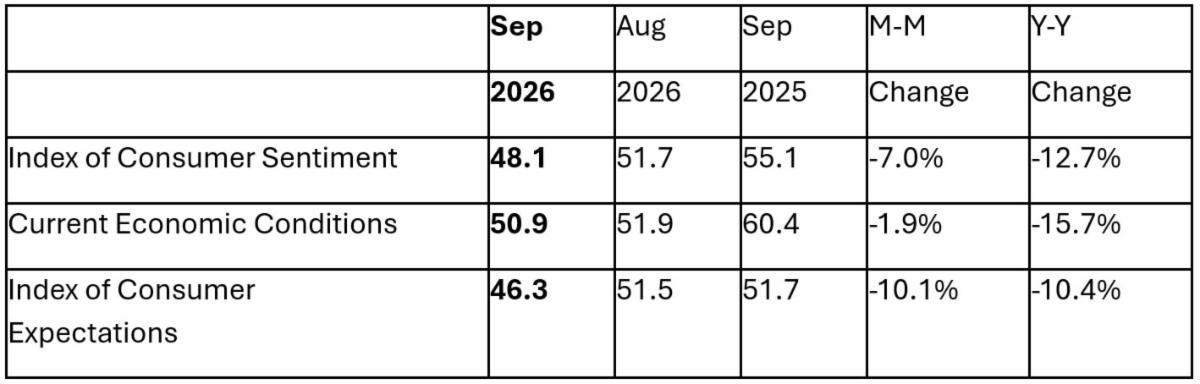
Consumer sentiment weakened in September (again), falling to a four-month low and about 15% below January levels, as high prices continue to pressure household finances. The economic outlook also deteriorated, with consumers increasingly concerned about elevated fuel costs and renewed trade tensions. Inflation expectations rose to 4.6% for the next year, signaling that consumers remain cautious about both spending and the broader economy.
September ISM Manufacturing PMI lands at 54.5%
Manufacturing stayed on solid footing in September, with the Institute for Supply Management (ISM) Manufacturing Purchase Managers Index (PMI) at 54.5%, marking the ninth straight month of expansion. Demand looked pretty healthy: new orders improved to 55.3%, backlogs jumped to 56.4%, and customer inventories remained very low, which could support continued production in the months ahead. Production was still strong at 56.7%, while employment improved to 52.7%. The biggest concern is cost pressure, with the Prices Index surging to 77.9% as manufacturers pointed to pricing volatility, tariffs, the Iran war, and longer lead times. Supplier deliveries also remained slow, while manufacturers reduced their own inventories. From a plastics perspective, the report was encouraging, with Plastics & Rubber Products among the industries reporting growth, along with electrical equipment and appliances, electronics, transportation equipment, machinery, furniture, and chemicals. Overall, manufacturing demand still looks reasonably strong, but rising raw-material costs, tariffs, and supply-chain delays are becoming a bigger issue heading into the fourth quarter.
Polymer Pricing
PC: North America pricing was flat month over month. Demand is stable to strong, with the better areas being hybrid-vehicle applications, electronics/electrical and medical applications. Construction remains sluggish as seen with lower housing starts, and broader automotive production is showing signs of slowing. In Asia Pacific, general-purpose PC was reported to have increased about 5 cpp month over month, but demand did not keep pace with the price increase and pre-holiday restocking was weaker than expected. The stronger markets are new-energy vehicles and auto components, industrial and service robots, drones, data centers, refrigerators, washing machines, and small appliances. Traditional passenger vehicles, computers, smartphones, and air conditioners remain weaker.
ABS: North American pricing was flat month over month while demand remains depressed across most end markets, with electronics the clearest relative bright spot. Appliances are stable to declining, automotive remains weak, and building/construction—including pipe, fittings and conduit—is slowing. In Asia Pacific, domestic ABS increased about 6-8 cpp month over month, while the imported ABS average increased about 6-8 cpp. Overall demand for ABS remains sluggish and buyers are purchasing mainly for immediate needs rather than building inventory. Appliances are the bright spot YTD, but September consumption was limited; electronics/electricals are holding up better than transportation and construction, which remain the weakest major markets.
PA6 and PA66: Just as we “went to press” with this edition, we saw 2 price increases for nylon 6 and 66 tied to benzene at 10 CPP for implementation October 1. Prior to that, North American pricing was flat month over month for both nylon 6 and nylon 66. Demand remains depressed, with automotive the biggest drag. No significant recovery is expected. Relative areas of stronger markets are electrical/electronic and wire-and-cable. In Asia Pacific, nylon 6 increased approximately 10-12 cents per pound (CPP) month over month and nylon 66 increased approximately 5-7 CPP. Domestic demand remains reduced by weak automotive production, although exports are providing support. Stronger markets are electrical/electronics, industrial machinery, film/coating and selected consumer applications, while traditional automotive remains the major weak spot.
PBT: North American PBT increased about a nickel month over month. Demand remains low, and the price increase is being driven primarily by raw material costs rather than stronger consumption. Automotive and electrical/electronics remain the main weak markets, and there is not yet a broad end-market recovery. In Asia Pacific, PBT increased approximately 7 CPP month-over-month, also largely cost-driven. Demand remains sluggish overall. Relative bright spots across the Chinese engineering-plastics markets include new-energy vehicles and auto components, robotics, data-center infrastructure, and some appliance applications, while traditional auto assembly, computers and smartphones continue to remain weak.
PP: North American homopolymer injection-grade PP decreased 3-6 CPP month-over-month; the report’s 20% talc-filled and 30% glass-filled engineering PP indexes each decreased about 2 CPP. Overall domestic demand has improved somewhat month over month, but distributors and resellers continue to report sluggish purchasing. Transportation/automotive remains weak, and there is no clear durable-goods recovery currently seen coming. In Asia Pacific, mainland China homopolymer PP increased about 7 CPP month over month. Overall demand remains subdued, but there are selective areas of improvement in woven bags and sacks for grain and fertilizer, hygiene nonwovens, household injection molding, impact copolymer/modified PP, and modestly improving automotive and appliance orders. High inventories, weak downstream margins, and cautious purchasing continue to hold back the broader market.
Mid-Month Market Update: Geopolitical Impacts
In mid-September, we sent out a mid-month update specific to the geopolitical environment and the issues created for oil and the downstream effects. Learn more here if you missed it.
Subscribe to Star’s Monthly Market Updates